

A polished floor depends on more than the final shine. Polished concrete professionals assess the slab, recommend a finish and plan the grinding and polishing process; standard 20 MPa concrete cannot be mechanically polished to last over time. The condition and suitability of the existing concrete are central to the decision.
It’s understandable to focus on colour, sheen and how the floor will look in the room. But a successful result also depends on sound preparation and a finish suited to how the space is used.
This guide explains how polished concrete professionals assess flooring projects, compare mechanical polishing with grind and seal, and prepare concrete for a durable finish. You’ll also learn what to consider in residential, commercial and industrial spaces, which project details shape the work, and how to move from an initial assessment to a clear flooring plan.
Key Takeaways
- Assess the existing slab before choosing a finish: standard 20 MPa concrete cannot be mechanically polished to last over time.
- Match the flooring method to how the space is used, from home interiors to busy commercial and industrial areas.
- Understand how grinding and surface preparation affect the finish, including the removal of old coatings and other residues.
- Check which qualifications and protections apply to the work; registration or licensing may be required for Floor Finishers in Australia.
Choosing a Melbourne concrete flooring specialist
As part of our national network, our expert polished concrete professionals across Australia, including Melbourne, assess the slab and explain the proposed finish before work begins. A written specification should connect the concrete's condition with the space's intended use.
Mechanically polished concrete flooring
Ask how the contractor will assess the existing concrete, select stone exposure and define the desired sheen. Standard 20 MPa concrete cannot be mechanically polished to last over time. For an existing floor, the process generally involves assessing the surface, grinding it, applying a hardener and polishing through progressively finer stages. Compare mechanical polishing with epoxy coatings or other synthetic floors by considering appearance, use and surface preparation.
Qualifications, insurance and warranties
Before hiring, ask who will carry out the work, what experience they have with similar floors, and what the written scope includes. The Australian Bureau of Statistics notes that registration or licensing may be required for Floor Finishers. Ask for relevant insurance details and written warranty terms, including coverage, exclusions and how to raise a claim. Clear documents define responsibilities before work starts.
Standards and building requirements
Requirements depend on the building's use and project specification. Ask the specialist to identify which Australian Standards and building requirements apply to the floor's intended use, access and performance. A home, warehouse and public commercial space can have different needs, so the specification should address the actual setting rather than assume one finish suits every site.
Risks, maintenance and limitations
Existing cracks can remain visible after polishing, and further concrete movement may affect the finish. Wet polished floors can be slippery, so consider moisture exposure and the selected surface finish. The Concrete Society recommends wet mopping polished concrete floors weekly with warm water, wiping spills promptly and avoiding harsh cleaners. Maintenance needs depend on floor area, traffic and cleaning requirements; project costs depend on the scope.
Residential, commercial and industrial polished concrete
The floor’s setting shapes its finish, preparation and care requirements. Consider how people, furniture and equipment will use each area before choosing concrete flooring.
Residential flooring applications
At home, consider how the floor will handle pets, furniture and daily foot traffic. Mechanically polished concrete can be difficult to scratch, making it a practical option for households with pets. Think about how stone exposure and sheen will look across connected spaces, such as a kitchen opening into a living room. A consistent finish can help those areas feel visually connected, while each room’s use still informs practical decisions.
Commercial and industrial flooring
Commercial and industrial floors need specifications suited to traffic, equipment and site operations. Warehouses with dense high-rack storage may use very narrow aisle flooring, where laser-guided superflat grinding supports precise warehouse operations. In data centres, consider equipment movement, access routes and cleaning routines when planning the floor. These operational details help determine the suitable surface finish and preparation.
For residential and commercial flooring projects, identify the areas that will receive the most wear. A busy entry, open-plan living area and storage zone each have different demands. Note traffic routes, furniture placement and cleaning routines to help tailor the specification. Durable flooring starts with understanding how people use the space, not just how it should look.
Industrial sites and warehouses also benefit from identifying equipment routes and areas where floor performance matters most. At home, appearance and routine care may carry greater weight. Where surface preparation is needed, concrete floor grinding can form part of the project plan. Matching preparation and finish to the setting helps the floor remain functional as use changes.
Professional concrete grinding and polishing services
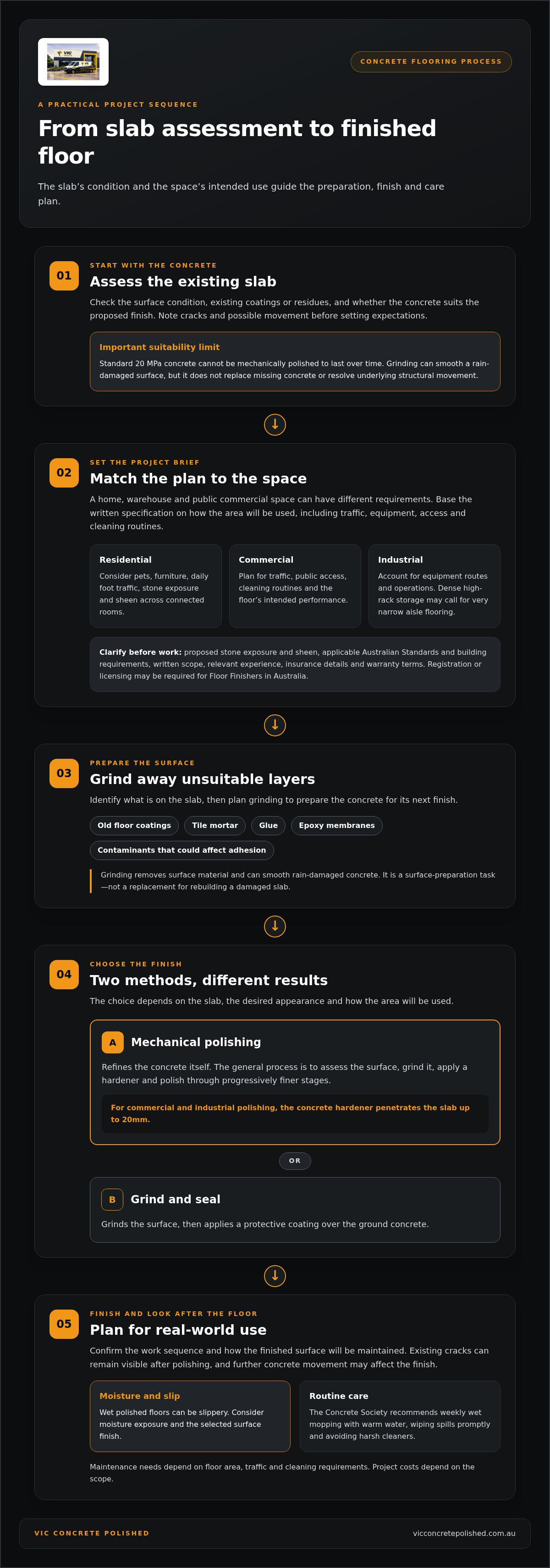
Good grinding work starts with the surface, not the shine. A clear sequence helps protect the slab and achieve the finish the space needs.
Yes, polished concrete professionals can grind outdoor concrete to smooth rain-damaged areas. Grinding removes surface material, but it doesn’t replace missing concrete or resolve underlying structural movement. The slab’s condition and intended use determine whether polishing suits the outdoor area.
For an existing floor, work begins by assessing the concrete and identifying coatings, glue or other residues. Grinding removes unsuitable surface layers and prepares the slab for its next finish. During mechanical polishing, progressively finer grinding refines the surface, while the chosen stone exposure and sheen shape the final appearance.
Preparation matters when planning a new coating. Grinding can remove old floor coatings, tile mortar, glue and epoxy membranes, while clearing contaminants that could interfere with adhesion. Rain-damaged concrete can also be smoothed through grinding. These are surface-preparation tasks, not substitutes for rebuilding a damaged slab.
Mechanical polishing and grind and seal produce different finishes. Mechanical polishing refines the concrete itself, while grind and seal applies a protective coating over the ground surface. The choice depends on the slab, the desired appearance and how the area will be used. For commercial and industrial polishing, the concrete hardener penetrates the slab up to 20mm.
Ask for the proposed work sequence, including assessment, grinding, surface treatment and finishing. This makes it easier to understand how existing coatings or damage may affect the result. It also clarifies whether the work involves polishing, preparation for a coating or smoothing an outdoor surface. The key is matching the method to the actual surface.
What qualifications, licences, insurance and warranties should polished concrete contractors have in Australia?
Start by checking who will assess the slab, operate the grinding equipment and oversee each stage. Ask about relevant training, experience with similar concrete floors and how the proposed finish will be documented. The Australian Bureau of Statistics notes that registration or licensing may be required for Floor Finishers. Requirements depend on the work and jurisdiction, so distinguish legal requirements from trade credentials.
Insurance is a separate consideration. Ask which policies cover the work, what activities they apply to and how property damage is handled. Request current documentation and check that the business name matches the agreement. For a commercial site, clarify how the work plan accounts for occupied areas, access restrictions and protection of nearby surfaces.
A written warranty should explain its scope, duration and exclusions in plain language. Look for details about the finished surface, coating or sealer, and the process for reporting a defect. Ask how cracking, stains, wear or damage caused by later work are treated. A warranty should clearly describe responsibilities, rather than rely on a general promise of durability.
Before signing, compare the written quote with the floor specification. It should identify the work stages, preparation, finish and any agreed site responsibilities. Ask who handles unexpected surface conditions and how changes are recorded. Keep the assessment, insurance documents, warranty terms and final specification together. These provide a practical record if questions arise during or after the project.
For a project that needs a clearly defined preparation plan, discuss floor preparation and measuring as part of the scope.
The Concrete Society says products that should not contact concrete surfaces include nail polish remover, bleach, oven cleaner, drain cleaner, permanent markers and paint strippers. Ask for this restriction to be included in the floor-care guidance, along with instructions for protecting the finished surface from these products during and after the work.
Vic Concrete Polished: Mechanical Polished Concrete
Vic Concrete Polished helps plan mechanically polished concrete projects by considering flooring options alongside preparation. Its Mechanical Polished Concrete service is suited to projects where the existing concrete is being assessed for a polished finish. Floor Preparation and Measuring supports project planning, while epoxy-resin and decorative flakes systems offer other flooring options to consider.
Turn to Vic Concrete Polished when you’re ready to discuss the surface, intended use and finish for a residential or commercial floor. Sharing those project details helps shape a practical conversation about the work involved and the appropriate flooring approach.
Contact Vic Concrete Polished to discuss your flooring project.
Plan your floor around its next use
A flooring decision can shape how a room feels and functions for years, so consider its future use alongside its current condition. Think about furniture, foot traffic, cleaning routines and the appearance you want to live or work with. These priorities give your project discussion a clear starting point.
Polished concrete professionals can help turn those priorities into a defined flooring scope. Vic Concrete Polished offers Mechanical Polished Concrete, Grind and Seal, and a Decorative Flakes Coating System, providing different approaches to consider for your project.
Bring your questions and project details together before taking the next step. A focused conversation can clarify which flooring direction suits your space and what preparation the work involves.
Contact Vic Concrete Polished to discuss your flooring project and take the next step with confidence.
Frequently Asked Questions
What services do polished concrete professionals offer in Australia?
Services can include mechanical polishing, grind and seal, epoxy-resin flooring and decorative flake coatings. Some flooring projects also need preparation before finishing, such as measuring, concrete grinding or removing existing tiles, carpet or vinyl. The right combination depends on the existing surface and intended result. For example, resin coating and mechanical polishing use different processes and create distinct floor surfaces.
How much does polished concrete cost per square metre in Australia?
There isn’t one cost per square metre that applies to every polished concrete project. The price depends on factors such as floor area, concrete condition, existing coverings, preparation required and selected finish. A project quote sets out the cost for the specific scope. Vic Concrete Polished provides free, no-obligation quotes after an initial consultation, so you can consider the proposed work alongside its cost.
How do I find and compare reputable polished concrete contractors near me?
Start by describing the floor, its current condition and how the space will be used. When comparing written quotes, check that each identifies the proposed finish, preparation and any removal work, rather than comparing totals alone. Ask for a clear scope and warranty terms. For a residential garage, for instance, make sure the quote specifies whether existing coatings need to be removed before applying the new floor finish.
How do polished concrete finishes, gloss levels and aggregate exposure compare?
Mechanical polishing refines the concrete itself, with stone exposure and sheen tailored to the project. Grind and seal grinds the surface to reveal the chosen aggregate level, then applies a protective sealer. Gloss describes how reflective the surface appears, while aggregate exposure describes how much stone is visible. Epoxy-resin and decorative flake finishes create a different coated appearance, so compare samples with the room’s lighting and colour scheme.


