

The word “polished” on a flooring quote doesn’t always mean the concrete itself has been mechanically polished. That’s why comparing honed and polished concrete by label alone can leave you unsure what finish you’re getting. Suppliers may use the terms differently, even though the process and surface treatment affect the floor’s appearance and upkeep.
It’s reasonable to expect a clear connection between a finish’s name, its appearance and how it will handle daily use. This guide explains how mechanical polishing refines the concrete itself, how grind and seal uses a protective coating, and where a honed finish fits into the comparison.
You’ll learn what these systems can look like, what to consider for upkeep, and why suitability for wet or outdoor areas depends on more than a finish name. The slab’s condition, your preferred appearance and how the floor will be used all help shape a suitable choice. The aim is a practical comparison based on the work involved and the space, not just the label.
Key Takeaways
- Finish names can vary between suppliers, so compare the process and surface treatment behind each description.
- Understand how honed and polished concrete differ in appearance and finishing method before choosing a system.
- Consider the room, traffic, moisture exposure and cleaning routine when weighing up a finish.
- Use the slab’s condition and your preferred look to guide the choice, rather than relying on labels alone.
- Mechanical polishing and grind and seal are distinct finishing approaches for residential and commercial spaces.
Honed and polished concrete: what do the terms actually mean?
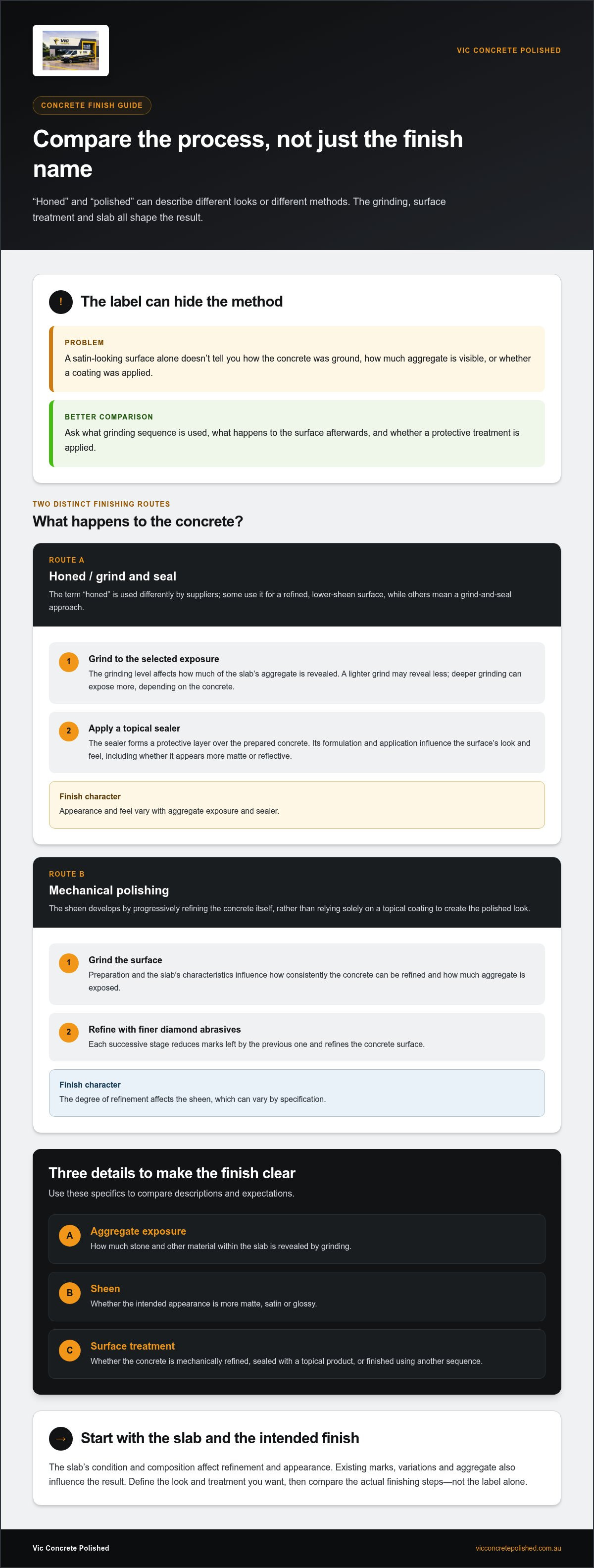
Finish names can vary because “honed” and “polished” are sometimes used to describe an appearance and sometimes a finishing method. That can make it difficult to compare honed and polished concrete from descriptions alone. A satin-looking surface, for example, doesn’t tell you how it was ground, whether a coating was applied or how much aggregate is visible.
For a useful comparison, separate the look you want from the steps used to produce it. Find out how the concrete is ground, what happens to the surface afterwards and whether a protective treatment is applied. These details matter for any space, and are especially important outdoors, where exposure and intended use also affect the decision.
Why ‘honed’ and ‘polished’ can mean different things
Some suppliers use “honed” for a refined, lower-sheen surface, while others use it for a grind-and-seal approach. “Polished” may mean mechanical polishing or simply describe a smooth or glossy appearance. Neither label establishes one universal process. Compare the steps used to finish the concrete, not just the name given to the result.
What a honed concrete surface describes
Honing generally describes concrete that has been ground to refine its surface, but trade usage differs. Grinding can expose little, some or more of the aggregate, depending on the slab and how much material is removed. A topical sealer may then be applied in a grind-and-seal system, but honed finishes don’t all use the same sealer or produce the same sheen.
Mechanical polishing also starts with grinding, then progressively refines the concrete using finer diamond abrasives. The sheen comes from refining the concrete itself, rather than relying solely on a topical coating to create the polished look. The grinding stages and the slab’s characteristics influence the final appearance. The overview of Polished concrete provides further background on the process and different gloss levels.
Even a precise-sounding finish label may leave important choices unstated. Before comparing options, distinguish these three elements:
- Aggregate exposure: how much stone and other material within the slab is revealed by grinding.
- Sheen: whether the intended appearance is more matte, satin or glossy.
- Surface treatment: whether the concrete is mechanically refined, sealed with a topical product or finished using another sequence.
These details turn a broad label into a clearer description of the surface. They also prevent assumptions: “honed” doesn’t automatically mean one level of exposure or a particular sealer, and “polished” doesn’t specify the sheen by itself. For an outdoor project, define the intended finish and treatment before deciding whether a description matches your requirements.
How honed and mechanically polished concrete are made
Both finishes depend on careful preparation. The concrete surface is assessed and prepared before grinding because the slab’s condition and composition affect how consistently it can be refined. Existing marks, variations and aggregate also influence the finished appearance. Preparation sets the foundation, while the finishing sequence determines whether the surface relies on a topical sealer or on refinement of the concrete itself.
| Stage | Honed or grind and seal | Mechanical polishing |
|---|---|---|
| Grinding | Grind to the chosen surface and aggregate exposure. | Grind, then progressively refine with finer abrasives. |
| Surface treatment | Apply a topical sealer to protect the prepared concrete. | Refine the concrete itself; the sequence may include additional treatments. |
| Finish character | Appearance and feel vary with exposure and sealer. | Sheen develops through mechanical refinement and can vary by specification. |
The honing and grind-and-seal sequence
For a grind-and-seal finish, grinding removes or smooths the surface to the selected level of aggregate exposure. A lighter grind may reveal less of the stone within the slab; deeper grinding can expose more, though the result depends on the concrete itself. Once the surface is prepared, a topical sealer is applied as a protective layer. Its formulation and application influence the look and feel, including whether the finish appears more matte or reflective.
A topical sealer creates the finish at the surface; mechanical polishing develops sheen by refining the concrete itself. That distinction is central to understanding the systems. The stages and expected result are outlined in this grind and seal concrete floor guide.
The mechanical polishing sequence
Mechanical polishing also begins with grinding, but continues through a progression of increasingly fine diamond abrasives. Each stage reduces the marks left by the previous one and refines the concrete surface. The slab and grinding decisions shape how much aggregate is exposed, while the degree of refinement affects the sheen. A mechanically polished floor can therefore be specified for different appearances rather than one fixed gloss level.
The American Society of Concrete Contractors’ technical resources provide guidance on polished concrete specifications and practice. For a closer look at the sequence, the mechanical polished concrete process guide explains how successive refinement shapes the surface. Vic Concrete Polished provides concrete finishing services, including mechanical polishing and grind and seal, with preparation matched to the slab and intended finish.
Appearance, upkeep, and suitability: what changes between finishes?
Honed and polished concrete can range from understated and matte to more reflective, but the finish name alone won’t tell you exactly what a floor will look like or how it will perform. Sheen, aggregate exposure, surface treatment and the slab all contribute to the result. For outdoor areas, consider those choices alongside moisture, foot traffic and how the space will be used.
How sheen and texture shape the look
A matte or satin appearance may suit a restrained outdoor setting, while a glossier surface can create a more reflective effect. Different finishing approaches may achieve either look, depending on the specification and products used. The amount of visible aggregate also depends on the concrete and how much material is removed during grinding. A sample or agreed finish description can help clarify the intended look before work begins.
Visual texture is not a reliable measure of slip resistance. A surface that appears rough or textured doesn’t automatically provide a particular level of grip, and a smooth-looking finish doesn’t establish how it will perform underfoot. In Australia, slip resistance can be assessed using methods set out in AS 4586. The relevant assessment depends on the intended setting and the finished surface, rather than the label “honed” or “polished”.
What to consider for wet, outdoor, and high-use spaces
Start with the conditions the concrete will face. A covered patio, an exposed entertaining area and a frequently wet entryway can each have different needs. Rain, water carried in on shoes, dirt and regular foot traffic may affect how the surface feels and how often it needs attention. Don’t assume a finish suited to one setting will suit another without considering its exposure and intended use.
Cleaning expectations matter too. Outdoor concrete may collect leaves, dust or other debris, while high-use areas can show marks and wear more readily. A topical sealer can influence the surface’s appearance and protection, but ongoing care depends on the product, exposure, traffic and maintenance. Mechanical polishing refines the concrete itself, but the process name alone doesn’t promise a set lifespan or eliminate routine cleaning.
Before deciding, weigh these factors together:
- Use: who will walk on the surface, and how frequently?
- Exposure: will it be sheltered, rained on or regularly damp?
- Care: what cleaning routine is practical for the household or site?
- Specification: what sheen, aggregate exposure and surface treatment are intended?
Durability and maintenance aren’t guaranteed by a finish name. They depend on the slab, preparation, chosen treatment, site conditions and ongoing care. Defining these details gives you a more useful basis for comparing options than assuming every honed finish suits wet areas or every polished surface behaves the same way.
How to choose between honed and polished concrete for your project
Start with how the area will be used, rather than choosing a finish from a photo. A sheltered entertaining area, a path exposed to rain and a busy entryway place different demands on a surface. The slab and its intended use should guide finish selection. Use this sequence to turn your priorities into a clearer brief for comparing honed and polished concrete.
- Describe the space. Note whether it’s a patio, walkway, entry or another area, and whether it’s open to the weather or partly sheltered. Consider where water may collect or be carried across the surface.
- Estimate the traffic and cleaning routine. Think about how often people will use the area, whether furniture or other items will move across it, and how you’ll remove everyday dirt and debris. Be realistic about the care you can maintain.
- Set the appearance you want. Decide whether you prefer a subdued matte or satin look, or a stronger sheen. Also consider how much aggregate you want visible. The slab’s existing aggregate distribution and condition can affect what grinding reveals.
- Describe the surface in practical terms. Record your preferences for exposure, sheen and texture, then consider how they relate to moisture and use. If slip performance matters, don’t infer it from an appearance or finish label. The complete surface and site conditions are relevant.
- Compare the finishing systems. Look for a written description of the grinding and finishing steps, including whether the surface is mechanically refined or receives a topical sealer. This makes it easier to compare the work proposed, not just whether it’s called “honed” or “polished”.
Check the slab and clarify the visual goal
Existing concrete may have marks, repairs, uneven areas or changes in aggregate distribution. These conditions can affect how evenly the surface can be refined and what the finished floor will show. A preferred exposure level in a photograph may not translate exactly to a different slab, so treat reference images as a guide rather than a promise of an identical result.
Where possible, use relevant finish samples or project images to discuss the intended appearance. Look beyond the overall colour: compare the visible aggregate, sheen and surface character. The aggregate exposure concrete floor guide can help explain how grinding influences what’s visible in the concrete.
Before settling on a finish, bring together the area’s use, exposure, care requirements, desired appearance and the slab’s condition. If you’re weighing up options for your concrete, discuss your concrete finishing project with Vic Concrete Polished.
How Vic Concrete Polished approaches honed and polished concrete
Choosing between honed and polished concrete starts with understanding the work behind each description. Vic Concrete Polished provides mechanical polished concrete and grind and seal finishes. These are distinct approaches, not universal synonyms for every use of “honed” or “polished”. A clear comparison looks at the surface preparation, grinding sequence and any sealer, then considers how those choices relate to the project.
That distinction is useful for indoor and outdoor floors alike. A finish name alone doesn’t establish the appearance, exposure level or performance of the completed surface. The slab, intended use and finish details all matter. Preparation and controlled grinding help shape the result, while the selected system determines how the concrete surface is treated.
Mechanical polishing and grind and seal as distinct approaches
Mechanical polishing progressively grinds and refines the concrete using increasingly fine abrasives. The sheen develops through this refinement, and the final appearance depends on the slab and chosen finishing sequence. It doesn’t guarantee one fixed gloss level or aggregate exposure.
With grind and seal, the concrete is ground to prepare the surface, then protected with a topical sealer. The sealer forms part of the finished surface and influences its appearance. This process differs from mechanically polishing the concrete itself, even if both finishes are described as “polished” in some settings. Neither approach should be assumed suitable for every slab or outdoor area without considering the project requirements.
From project requirements to a considered finish
Vic Concrete Polished provides floor preparation and finishing to suit the project brief. Relevant details include:
- Intended use: how the area will be used and the foot traffic it may receive.
- Slab condition: the existing concrete and how its characteristics may affect preparation and the achievable result.
- Appearance preferences: the desired sheen, aggregate visibility and overall surface character.
- Finishing approach: whether progressive mechanical refinement or a ground-and-sealed surface better aligns with the project brief.
These considerations help set realistic expectations. An appearance reference can communicate a preferred look, but the existing slab may have different aggregate distribution or surface conditions. The final outcome is shaped by both the concrete and the work carried out on it, so preparation is part of the finish, not a step to overlook.
Vic Concrete Polished works on residential and commercial surface finishing, with floor preparation supporting the finishing process. The aim is to match the approach to the slab, intended use and desired appearance, rather than treating different labels as interchangeable. This provides a practical basis for discussing concrete flooring and setting expectations for the finished surface.
If you’re weighing up options for your slab, you can discuss your concrete finishing project with Vic Concrete Polished.
Set your priorities before choosing a finish
Turn your preferences into a short project brief. Note what matters most in the finished space, whether that’s a particular surface character, a manageable care routine or confidence about how the floor will be used. For honed and polished concrete, clear expectations make it easier to discuss the result you’re aiming for without relying on a finish label to convey every detail.
Bring together your ideas about the setting, existing concrete and preferred appearance. Where possible, use a relevant sample or project image to explain what you mean by sheen, texture and aggregate visibility. This gives the finishing conversation a practical starting point and connects the desired look with the work involved.
Vic Concrete Polished can help you consider the project requirements and discuss a suitable finishing approach. Discuss your concrete finishing project and take the next step towards a surface that suits your space.
Frequently Asked Questions
Can honed concrete be installed over tiles?
Not usually as a direct finish over the tiles themselves; the existing floor covering and substrate need assessment first. Tiles may need to be removed so the concrete beneath can be prepared and its condition considered. Tile removal and concrete preparation are groundwork, not the honing method. Whether the exposed slab can achieve a suitable honed finish depends on its condition and the project requirements, so a tiled floor shouldn’t be assumed suitable without assessment.
How long does honing or polishing a concrete floor take?
There’s no standard duration that applies to every floor. Timing depends on the area, slab condition, preparation required, selected finish and access to the site. Grinding and finishing involve multiple stages, and the schedule needs to allow for preparation as well as the final surface treatment. A floor with existing coatings or repairs, for example, may need different preparation from a clear, consistent slab.
Does concrete need to cure before it can be honed or polished?
Yes, the concrete needs to be in a suitable condition for mechanical finishing, but there’s no universal curing period for every project. Newly poured concrete and an existing slab present different circumstances: a new slab needs time to reach appropriate readiness, while an older floor may have wear, coatings or repairs to assess. Reviewing the surface and project conditions helps determine a suitable finishing approach and timing.
Can colour be added to honed or polished concrete?
Colour may form part of the design, but it can’t be assumed to work identically across all concrete finishes. The slab’s existing colour, aggregate and exposure affect the result, while the finishing system influences how those features appear. Discuss the colour you’re aiming for alongside the concrete’s characteristics and the proposed process. A sample or relevant project image can help clarify expectations before settling on a finish.
Will honed concrete show stains?
It can. How visible a stain becomes depends on the concrete surface, any sealer, the spill, exposure and ongoing care. A topical sealer can add a protective layer, but it doesn’t make a floor stain-proof. Leaves left damp on an outdoor surface or a household spill may leave marks if not cleaned promptly. Remove spills as soon as practical and follow care guidance for the selected finish.
Can an existing concrete slab be mechanically polished?
An existing slab may be suitable for mechanical polishing, but its condition needs to be considered first. Previous coatings, repairs, surface wear and the concrete’s characteristics can all affect preparation and the result. They may also influence how much aggregate is revealed and the sheen that can be achieved. An assessment helps set realistic expectations, since a particular exposure or gloss can’t be guaranteed from the slab’s age alone.
Is honed concrete always the same as grind and seal?
No. Trade usage varies, so “honed” and “grind and seal” aren’t reliable substitutes in every description. Some suppliers use honed for ground concrete protected with a topical sealer, while others distinguish honing from polishing differently. For a clearer comparison of honed and polished concrete, look at the grinding sequence, aggregate exposure and sealing steps described, rather than relying on the label by itself.


