

An existing concrete slab can be mechanically polished once old floor coverings are removed, so a worn surface does not automatically need another covering. The slab’s condition and the aggregate revealed during grinding help determine the finish. Grind and seal or a decorative coating may suit concrete that will not polish consistently.
It is reasonable to want a durable, practical floor without knowing what lies beneath old tiles, carpet or vinyl. This guide explains what affects whether concrete can be polished, how cracks, adhesive and surface damage influence the result, and which renovation options may suit a home, commercial space or industrial site.
You will also learn how floor preparation fits into the process and what to consider when choosing a finish. This helps you understand the options before deciding how to renew the concrete underfoot.
Key Takeaways
- Learn what slab condition, surface residue and aggregate can reveal about whether mechanical polishing is suitable.
- See when grind and seal or a decorative coating may be a more practical finish for an existing floor.
- Understand how renovation timing and the intended use of a space influence floor preparation and finish choices.
- Explore ways to renew concrete in homes, commercial spaces and industrial sites, and identify the approach that best fits your priorities.
Can You Lay Polished Concrete Floors on an Existing Slab in Melbourne?
Yes. After old floor coverings are removed, an existing concrete slab can be ground and mechanically polished, provided its condition supports the finish. When undertaking an existing concrete floor renovation Melbourne wide, property owners can choose from options including mechanical polishing, grind and seal, epoxy coatings and decorative overlays.
Renovation method options
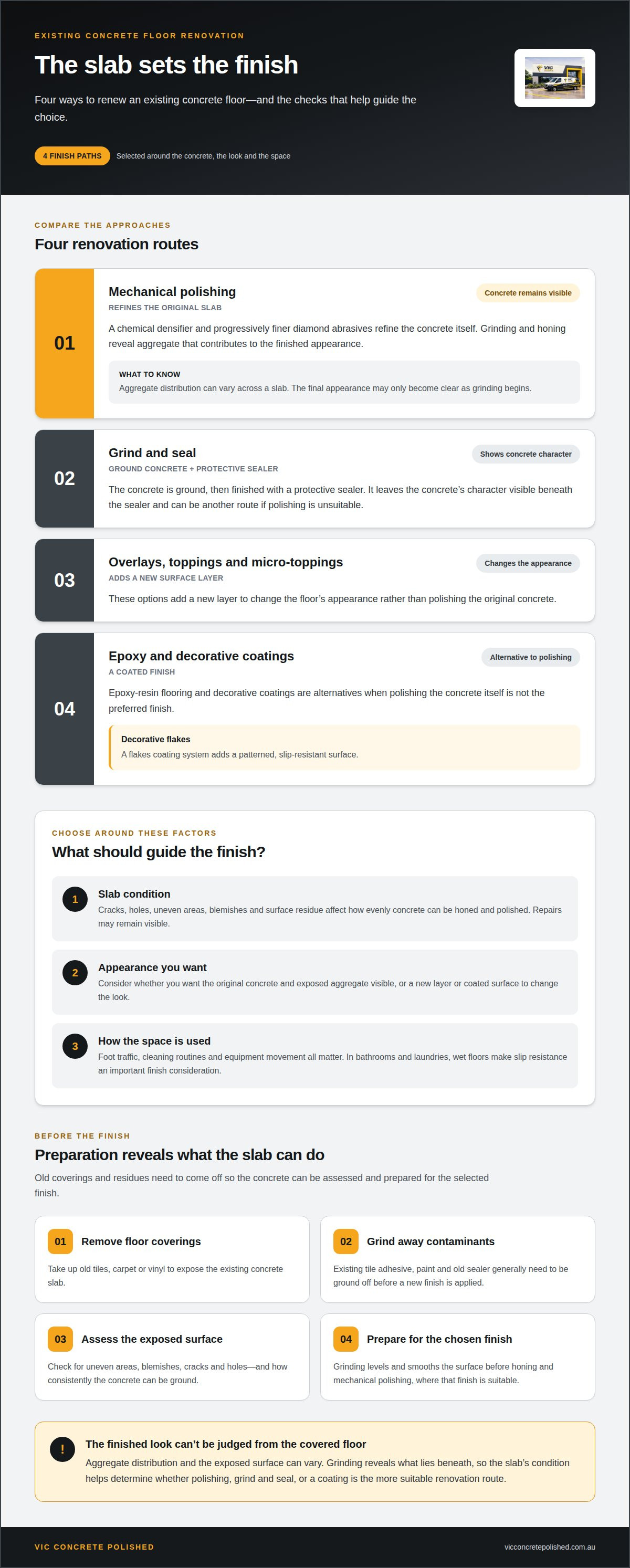
Mechanical polishing uses a chemical densifier and progressively finer diamond abrasives to refine the slab itself. Grinding and honing prepare the surface, while the exposed aggregate contributes to the finished appearance. Aggregate distribution can vary across an existing slab and may only become clear as grinding begins.
Grind and seal is another option: the concrete is ground, then finished with a protective sealer. Overlays, toppings and micro-toppings add a new layer to change the appearance rather than polishing the original concrete. Compare the approaches based on the slab’s condition, the look you want and how the floor will be used.
Coatings and epoxy flooring
Epoxy-resin flooring and decorative coatings are alternatives when polishing the concrete itself is not the preferred finish. A decorative flakes coating system adds a patterned, slip-resistant surface, while grind and seal leaves the concrete’s character visible beneath a protective sealer. Choose based on the surface, the appearance you want and the demands of the space.
Existing paint, adhesive and old sealers generally need to be ground off before a new finish is applied. For example, peeling epoxy can leave a surface that needs preparation before another coating or sealer is installed. Removing residue exposes the concrete and prepares it for the selected finish.
Grinding and slab preparation
Preparation starts with removing floor coverings and grinding away contaminants such as tile adhesive, paint or old sealer. The exposed concrete can then be assessed for uneven areas, blemishes, cracks and holes. These conditions affect how evenly the slab can be honed and polished, and how visible repairs may be in the finished floor.
Grinding levels and smooths the surface before honing and mechanical polishing. Aggregate may be unevenly distributed, so the final appearance cannot be judged fully until grinding reveals what lies beneath. If damage, contamination or inconsistency makes polishing unsuitable, grind and seal or a decorative coating can offer another renovation route.
Polishing an existing concrete slab during a Melbourne home renovation
A Melbourne home renovation can retain its concrete slab as the finished floor, with the result shaped by the exposed surface and chosen finish. Permit considerations depend on scope: surface polishing differs from work that changes the slab or building structure.
Assessing the existing slab
Assessment considers cracks, holes, surface contamination and how consistently the concrete can be ground. In Melbourne, reactive clay soils can contribute to slab movement, so cracks need assessment for signs of ongoing movement. Filler repairs often remain visible because their colour and texture rarely match surrounding concrete.
Renovation timing also affects the finish. In a Melbourne home, polished concrete is generally installed after demolition and heavy trades, but before cabinetry and skirting boards. This sequence leaves room to work across the floor without finished fittings obstructing preparation.
Matching polished concrete finishes
Matching a new polished concrete floor to existing areas depends partly on the concrete itself. Aggregate distribution and the exposed surface can vary between slabs, affecting colour, texture and overall appearance. Carpet removal may also reveal marks, patches or differences that change how adjoining floors look together.
For example, an existing polished area and a newly ground section may expose different aggregate. A consistent finish across both areas depends on the concrete revealed during preparation, not just the selected appearance. A measured assessment of the concrete floor preparation can help establish how the surface may respond.
Finish levels and grit
Mechanical polishing uses progressively finer diamond abrasives to refine the concrete towards the selected finish. Matte or satin polished concrete generally offers more traction than a high-gloss finish. Choose based on the room’s use and lighting as well as its appearance.
Maintenance and repairs matter after installation. Regular cleaning helps manage everyday dust and marks, while sealing helps protect concrete from stains and other damage. Heavy foot traffic or moving furniture can cause damage; cracks and holes may need filling, with repairs remaining visible. In homes, rugs can make a polished floor more comfortable during Melbourne winters.
Residential, commercial and industrial suitability
Choose a renovation finish around how each space is used. A Melbourne home, retail floor and warehouse place different demands on the concrete surface, from everyday foot traffic to practical cleaning needs.
In residential rooms, polished concrete can create a continuous, easy-to-clean surface, but it may feel cold underfoot during Melbourne winters. Homeowners can use rugs or consider a floor warmer for added comfort. For bathrooms and laundries, wet floors make slip resistance an important part of selecting the finish. A beautiful appearance should work alongside safe, practical use.
Commercial spaces such as shops and offices benefit from a finish matched to how people move through the area. Grind and seal leaves the concrete visible beneath a sealer, while epoxy flooring provides a coated surface. Consider foot traffic, cleaning routines and the look needed across adjoining rooms. In industrial spaces and warehouses, the intended use and movement of equipment also shape the suitable flooring system.
Preparation changes when an older floor has several types of residue. After tile removal, tile adhesive can be ground from the slab, although chips, marks or patches may remain and affect the final appearance. Peeling epoxy and membrane residue also need to be removed before refinishing. Grinding residue from a small laundry floor, for example, is a different task from clearing adhesive across a shop floor.
Protect the finished surface by following a clear sequence: remove coverings and residue, prepare the concrete, then apply the selected finish. This exposes the actual slab before the finish is chosen. Rooms where a natural concrete look is preferred may suit polishing; a workshop or warehouse needing a coated surface may call for a different system. Suitability depends on the slab’s condition, the space’s use and the finish’s maintenance needs.
Renovating existing concrete floors
Renovating an existing floor starts with deciding whether to expose the slab or apply a new finish. For existing concrete floor renovation Melbourne projects, begin with the intended use of the space and the condition of the concrete beneath its coverings. A shop with worn adhesive needs residue removed before the slab can be assessed. At home, lifting carpet may reveal marks that affect the finish you want.
A practical sequence is to remove coverings, grind the concrete, assess defects, then select a finish. Cracks, breaks, separated joint filler and spalling can affect the result. Repairs may remain visible, so the finished floor will not necessarily look uniform. In a retail space with regular foot traffic, priorities may differ from those in a quiet room at home.
Concrete grinding removes high spots and surface residues, creating a prepared base for further work. The preparation required depends on what remains after removal: tile adhesive, peeling coating and membrane residue each present a different challenge. In a factory, an old coating may need grinding away before a new system is installed. Proper preparation supports a durable finish.
Consider how the renovated surface will meet adjoining materials. Polished concrete beside timber boards may create a clear transition in height or appearance. A gloss finish can reflect more light, while a lower sheen gives the floor a different character. These details help turn a tired slab into a surface suited to the room’s layout and everyday use.
Repairs and preparation shape the outcome as much as the final treatment. Widespread contamination may require more grinding than a clean, sound slab, while localised damage may need targeted repairs. For an existing concrete floor renovation Melbourne property owners should choose the finish after the exposed concrete has been assessed. This sequence helps match the result to the slab and the space.
Vic Concrete Polished
Vic Concrete Polished helps you choose a practical renovation approach based on your existing slab’s condition and how the space is used. Its flooring services include preparation and grinding, followed by a suitable finish for the project.
Where the concrete is suitable for polishing, Mechanical Polished Concrete can reveal and refine the existing surface. Grind and Seal offers another way to finish prepared concrete, while the Decorative Flakes Coating System and Epoxy - Resin provide coated alternatives. Comparing these options helps match the slab’s condition and your preferred appearance to the space’s everyday use.
Planning an existing concrete floor renovation in Melbourne? Contact Vic Concrete Polished to discuss your floor and choose an approach suited to its condition and use.
Plan the next stage of your floor renovation
The next step for an existing concrete floor renovation in Melbourne is to turn your priorities into a clear finish plan. Consider how the space is used, the appearance you want and the practical demands the floor must meet. These decisions give the renovation direction before work begins.
Vic Concrete Polished offers Mechanical Polished Concrete, Grind and Seal, and the Decorative Flakes Coating System. Share what the existing floor is covered with, how the room is used and what you want the finished surface to achieve. This helps shape a practical plan for preparation and a suitable finish, without assuming every slab needs the same treatment.
Take the next step at a pace that suits your renovation plans. Contact Vic Concrete Polished today to discuss the floor you want to renew. A considered plan is a practical start towards a finish that works for your space.
Frequently Asked Questions
Need help choosing the right concrete polishing method for your renovation in Melbourne?
Start with the slab’s condition and the demands of the room. A sound slab whose appearance you want to reveal may suit mechanical polishing; a surface better suited to a topical sealer may call for grind and seal. For garages or work areas, consider cleaning needs and everyday use. These factors help narrow down the finish.
What are the main reasons for choosing polished concrete for your flooring needs?
Polished concrete can turn an exposed slab into the finished floor, avoiding a separate covering such as carpet or tiles. Its continuous surface suits open-plan layouts, where fewer visible joins can create a unified look between rooms. The finish also keeps the concrete’s natural character visible. Consider comfort and everyday use as well as appearance before choosing this option.
How does the concrete floor renovation process work?
The work generally follows a sequence: remove existing coverings, prepare the exposed concrete, address surface defects, then apply the selected finish. The preparation required depends on residues and damage beneath the old flooring. Before installation, clarify the scope and intended appearance, including how the renovated area will meet doorways and adjoining floors. This planning helps coordinate floor work with the wider renovation.
What types of concrete flooring are available?
Common options include mechanical polishing, grind and seal, epoxy-resin flooring and decorative flake coatings. They differ in how the concrete is finished and whether a coating is applied over it. A homeowner wanting to show the slab’s character may prefer polishing, while a garage may suit a coated surface. Match the method to the existing concrete and the space’s practical requirements.
What do concrete flooring services include?
Concrete flooring work can include measuring, floor preparation, grinding and removing existing tiles, carpet or vinyl. The finish may then be mechanical polishing, grind and seal, epoxy-resin flooring or a decorative flakes coating system. The scope depends on the floor covering, the exposed slab and the result you want. For example, a tiled room needs its covering removed and adhesive prepared before the concrete can be refinished.
How much does concrete floor polishing cost per square metre in Melbourne?
The cost per square metre depends on the floor area, slab condition, existing coverings, preparation required and selected finish. Vic Concrete Polished provides free, no-obligation quotes after an initial consultation, based on the project. A slab requiring covering removal and extensive grinding involves different work from a clear surface ready for polishing. A project-specific quote gives you a relevant basis for planning.


