

A glossy concrete floor isn’t automatically slippery, but water and other contaminants can reduce its grip. Whether polished concrete is slippery when wet depends on more than shine: the floor’s condition, footwear and anything on the surface all matter.
It’s understandable to associate a high-gloss finish with a slick surface, especially where rainwater or spills may be tracked indoors. But appearance alone doesn’t show how securely people can walk on the floor. A surface may also behave differently when wet than when dry.
This guide explains how gloss relates to grip and how floor condition, footwear, traffic, cleaning and contaminants affect traction. It also covers wet-weather exposure and practical ways to manage slip risks in your space.
Key Takeaways
- Look beyond the floor’s shine: finish appearance alone doesn’t tell you how much grip it provides underfoot.
- Consider wear, cleaning, footwear and foot traffic together, as each can affect how the surface performs over time.
- Pay particular attention to wet-weather entrances and other areas where moisture may be tracked across the floor.
- Promptly remove water, oil, grease and other spills to help reduce the chance of slips.
Does a glossy floor automatically have low slip resistance?
No. Gloss alone doesn’t indicate how much grip polished concrete provides. Wet performance depends on the surface tested and the conditions during testing.
Gloss level and slip resistance
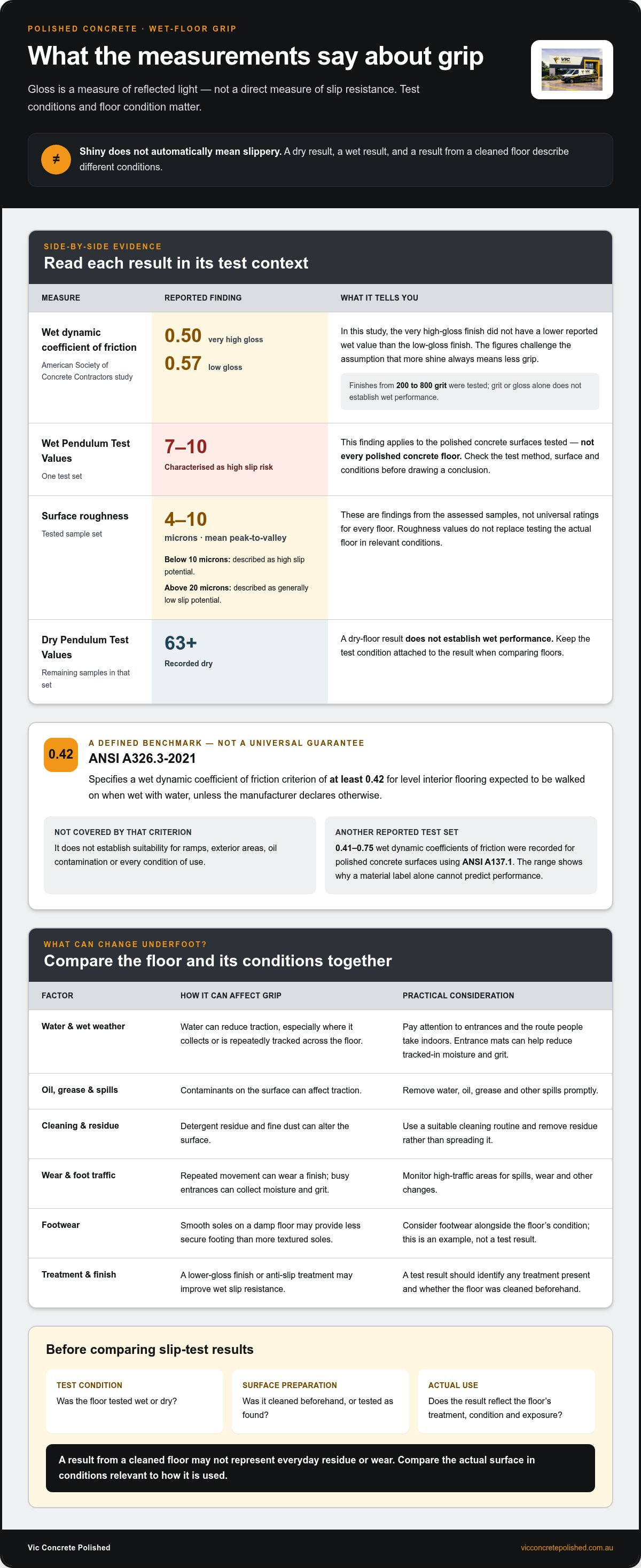
Gloss describes how much light a concrete surface reflects, not its measured slip resistance. That distinction matters because a shiny appearance can’t tell you how the floor will feel underfoot when wet. An American Society of Concrete Contractors study measured wet dynamic coefficients of friction of roughly 0.50 for very high-gloss finishes and 0.57 for low-gloss finishes. The result challenges the assumption that more shine always means less grip. The company tested finishes from 200 to 800 grit, but grit or gloss alone doesn’t establish wet performance.
In Australia, interpret slip-test results in relation to the floor’s intended use and condition. A dry-floor result doesn’t establish how that surface performs when wet. Testing after cleaning assesses a prepared floor, while prevailing-condition testing assesses the floor as found, subject to the method’s preparation requirements. For instance, a result recorded after cleaning may not represent a floor with everyday residue or wear. The test method and conditions matter as much as the reported result.
Comparing wet-floor materials
Polished concrete, honed concrete, tiles and epoxy can’t be ranked for wet grip by material name alone. Honed concrete is less reflective, but that appearance doesn’t prove it offers better traction. Tiles and epoxy also vary according to their finish, treatment and condition. So, is polished concrete more slippery than honed concrete, tiles or epoxy when wet? There’s no universal answer based on material. Compare test results for the actual surfaces in relevant wet conditions.
A useful slip-resistance report identifies whether testing was wet or dry and whether the floor was cleaned beforehand. It should also identify any treatment present, since a result taken before treatment describes the earlier surface. Wet Pendulum Test Values of 7-10 were recorded across the polished concrete surfaces in one test set, characterised as high slip risk. That finding applies to those tested surfaces, not every polished floor. Reading the method and conditions prevents a single number being mistaken for a universal result.
Floor condition, footwear, traffic and maintenance
Wet grip can change as polished concrete is cleaned, worn or contaminated. To improve wet slip resistance, consider a lower-gloss finish or an anti-slip treatment. Regular cleaning and prompt spill removal also help prevent residue from reducing traction.
Surface texture offers another clue, but it needs careful interpretation. In one tested sample set, polished concrete had total mean peak-to-valley roughness values of 4-10 microns. The accompanying assessment described surfaces below 10 microns as having high slip potential. This is a finding about tested surfaces, not a universal rating for every floor.
Test results can also differ with the surface condition and method. The remaining samples in that set had dry Pendulum Test Values of 63 or higher. That dry result doesn’t establish wet performance. The same assessment described surfaces exceeding 20 microns of roughness as generally having low slip potential. Neither figure replaces testing the actual floor in relevant conditions.
Cleaning affects what remains underfoot. Detergent residue and fine dust, for example, can alter the surface. Use a cleaning routine suited to the floor, and remove residue instead of spreading it. Traffic matters, too: repeated movement can wear a finish, while busy entrances collect moisture and grit. Entrance mats can help reduce both.
Footwear also affects how people move on a floor. Someone wearing smooth-soled shoes on a damp entrance floor may have less secure footing than someone wearing shoes with a more textured sole. This example isn’t a test result; it shows why footwear and floor condition should be considered together. Monitor busy areas for spills, wear and other changes.
If cleaning and entrance controls don’t address a persistent surface issue, professional floor surface preparation can form part of a considered response.
Polished concrete and wet-weather slip risk
Rainwater tracked indoors can change how polished concrete feels underfoot. The risk depends on the surface, the wet conditions and how the area is used.
Wet-weather slip risk
Water can reduce traction on polished concrete, particularly where it collects or is repeatedly tracked across the floor. ANSI A326.3-2021 specifies a wet dynamic coefficient of friction criterion of at least 0.42 for level interior flooring expected to be walked on when wet with water, unless the manufacturer declares otherwise. This is a defined criterion, not a guarantee for every floor or situation.
That criterion doesn’t establish suitability for ramps, exterior areas, oil contamination or every condition of use. One tested set of polished concrete surfaces had wet dynamic coefficients of friction from 0.41 to 0.75 using ANSI A137.1. The spread shows why a general label such as “polished concrete” can’t predict performance. Consider the actual surface and exposure, including water tracked in during wet weather.
Suitability across wet areas
Bathrooms, kitchens and outdoor areas each present different wet-floor conditions, so suitability depends on the location and exposure. A bathroom may have water around a shower, while a kitchen may experience splashes or spills. An outdoor path can face rain and changing conditions. The ANSI A326.3-2021 criterion applies to level interior flooring, not ramps or exterior areas, so it can’t answer every location question.
In a bathroom or kitchen, consider where water reaches the floor and whether it can remain there. Outdoors, account for direct rain and the route people take across the surface. A benchmark for a level interior doesn’t prove a floor is suitable for a ramp or exposed area. Assess the wet test result, floor condition and intended use together.
Polished concrete isn’t automatically suitable or unsuitable for any of these spaces. Match the finish and assessment to the exposure rather than relying on appearance or a result from another setting. This matters particularly where wet feet, tracked-in rain or standing water are part of everyday use.
Effects of water, oil, grease and other contaminants
Water, oil, grease and other contaminants can reduce traction and make polished concrete slippery. Even a thin film may interfere with contact between shoes and the floor. Rainwater tracked through an entrance can spread beyond the doorway, while a kitchen spill can leave a slick patch. The contaminant, its location and how far it spreads all affect conditions underfoot.
Oil and grease need particular attention because they can leave a film rather than an obvious puddle. A drop near a workbench or cooking area may spread under passing shoes and carry residue onto nearby concrete. Dust and cleaning residue can also change the surface underfoot. A floor that looks clean may still have a thin layer that affects traction.
Act promptly when a spill occurs. First, keep people away from the affected area. Absorb the liquid with a suitable material, then clean the floor using a method appropriate for the surface and contaminant. Follow the cleaning product directions and remove residue rather than spreading it. Make sure the area is dry before reopening the route.
Rain creates a different pattern: moisture may enter on shoes, umbrellas or wheeled items, then travel along a busy route. Place entrance mats where people come inside and maintain them so they collect moisture and debris. Check around sinks, cooking areas and entrances during routine cleaning. These checks can help identify recurring contamination that needs closer attention.
Testing conditions matter where contamination affects an assessment. Under ANSI A326.3-2021 prevailing-condition testing, obvious solid contaminants are removed and documented, but the floor isn’t otherwise pre-cleaned. This distinguishes an as-found assessment from a prepared surface test. For persistent floor issues, discuss concrete floor grinding as part of an assessment of the concrete surface and its condition.
Vic Concrete Polished: Mechanical Polished Concrete
Vic Concrete Polished provides Mechanical Polished Concrete for property owners considering a polished finish. If wet-weather grip is a concern, discuss how the floor will be used, where moisture reaches it and which finish suits the space. This keeps the conversation focused on the surface and its intended use, rather than gloss alone.
Floor condition matters, too. Concrete floor grinding and floor preparation and measuring can address the existing surface as part of planning the work. These services are a useful starting point when renovating a floor or considering polished concrete in an area exposed to water. Share where the floor is and how it’s used to guide the discussion.
Contact Vic Concrete Polished or visit vicconcretepolished.com.au to discuss your flooring project.
Plan a floor around its real use
Before choosing a finish, map how people move through the space and where moisture or spills are most likely. A kitchen entrance, bathroom threshold and outdoor walkway face different conditions, so assess the actual setting. Whether polished concrete is slippery when wet depends on those conditions and the floor’s state, not appearance alone.
Bring that context into your flooring discussion: note the room, typical traffic, cleaning routine and recurring wet patches. Consider how the floor should look, how it will be used and what maintenance suits the space. This gives the project a practical starting point and helps match the surface to everyday needs. Vic Concrete Polished also offers Grind and Seal and Decorative Flakes Coating System as alternative flooring options.
Contact Vic Concrete Polished to discuss a flooring option for your space. A considered choice can help you plan a floor that works well for daily life.
Frequently Asked Questions
What does a DCOF value of 0.42 mean?
A DCOF of 0.42 is the wet dynamic coefficient of friction criterion in ANSI A326.3-2021 for level interior flooring expected to be walked on when wet with water, unless the manufacturer declares otherwise. It relates to a defined test, using specified equipment and solution. It isn’t a universal pass mark for every floor, ramp, outdoor area or contaminant.
Is polished concrete slippery when wet?
It can be, depending on the wet conditions and the specific floor. The label “polished concrete” doesn’t explain how people will move across a surface after rain, a splash or a spill. An entryway where people arrive in wet shoes, for example, faces different exposure from a dry room. Consider the floor’s intended use and the conditions people encounter there.
What slip-resistance rating does polished concrete have when wet in Australia?
There isn’t one wet slip-resistance rating that applies to every polished concrete floor in Australia. Results describe a particular surface tested using a particular method and condition. For a useful comparison, check whether the test was conducted wet, which method was used and whether the floor had a coating or treatment. A rating for another surface or condition may not represent your floor.
How is wet slip resistance tested and classified under Australian standards?
Wet slip resistance is assessed by testing a floor using a specified method, then interpreting the result for its intended use. Pendulum Test Value is one measure used for situation-specific recommendations. The test report should identify the method, wet or dry conditions and surface treatment. Any classification should relate to the tested surface and relevant use, not just its material name.
Does polished concrete become more slippery when sealed or polished to a higher gloss?
Not automatically. High gloss alone doesn’t establish a floor’s wet grip, and when a surface is sealed or otherwise treated, the treated floor is what matters. For example, a result recorded before sealing describes the earlier surface, not the finished floor. Consider the final treatment and conditions of use together rather than treating shine as a reliable guide to traction.
What factors affect the slip resistance of polished concrete floors?
Grip depends on the floor’s texture and condition, moisture or other contaminants, footwear, traffic and cleaning. A shoe sole meets a different surface when it carries rainwater or kitchen residue, for instance. Wear and cleaning can also change test results over time. Assess how the area is used, including where people enter and where spills are likely.


