
A commercial grind-and-seal floor doesn’t have one fixed resealing date. For many Australian businesses, the answer to how often to reseal a grind and seal floor is every 2 to 5 years, with traffic, chemical exposure and sealer type all affecting the timing. A grind-and-seal finish uses a protective coating over ground concrete, and that coating provides the floor’s gloss and wear protection.
It makes sense to want a clear schedule, especially when a floor needs to handle daily business activity without losing its finish. Use any resealing interval as a starting point, then consider how the space is used and how the surface is holding up.
This article explains typical resealing intervals for different commercial settings, the signs that a coating may be wearing, and how cleaning habits and floor conditions influence its lifespan. You’ll also learn how a grind-and-seal finish differs from mechanically polished concrete, so you can better understand the care your floor needs.
Key Takeaways
- Use your business type and floor traffic to shape a resealing schedule, rather than relying on one interval for every space.
- Watch for changes in sheen, visible wear and surface absorption as possible signs that the coating needs attention.
- Regular sweeping, prompt spill clean-up and pH-neutral cleaning can help protect the finish between reseals.
- Consider the slab’s condition, chemical exposure and daily traffic when deciding what preparation the floor may need.
How often should commercial concrete floors be resealed?
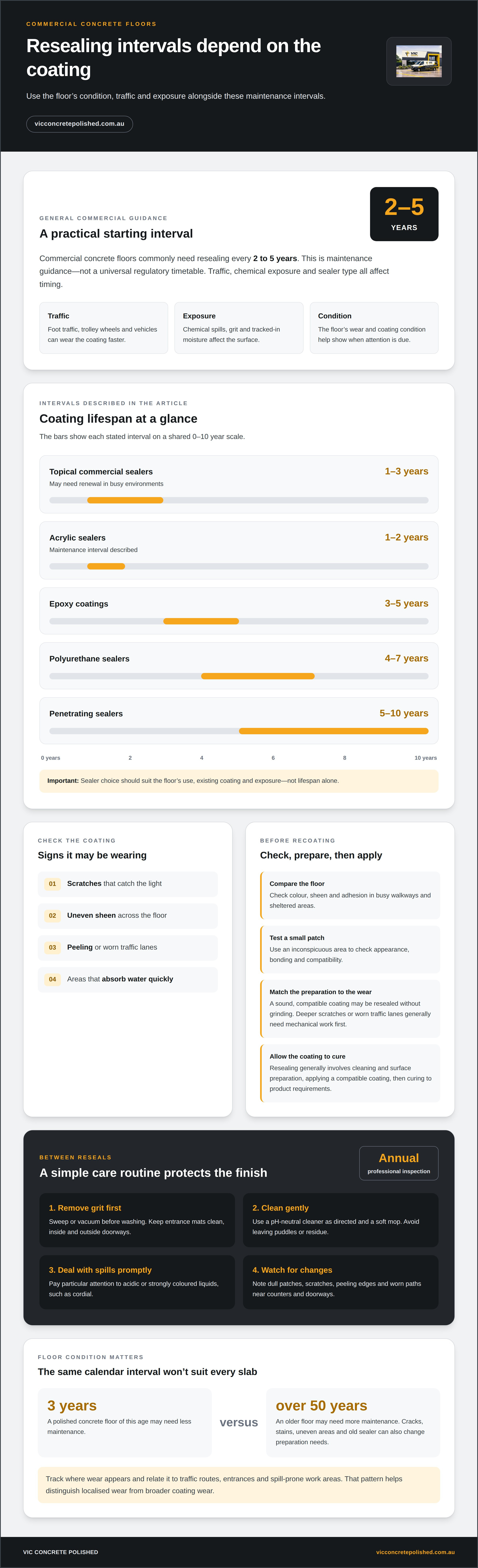
Commercial concrete floors commonly need resealing every 2 to 5 years, depending on traffic, chemical exposure and sealer type. The figures are practical maintenance intervals, while the floor’s condition helps show when attention is due.
Factors affecting sealer life
Sealer life depends on the wear and exposure the concrete receives. Heavy foot traffic, trolley wheels and vehicles can wear a coating faster, while chemical spills may damage it if left in place. Grit and moisture tracked indoors also affect the surface. These intervals are maintenance guidance, not a universal regulatory timetable for Australian floors.
Testing sealer condition
Compare the coating’s colour, sheen and adhesion across the floor. Look for differences between busy walkways and sheltered areas, then test a small, inconspicuous patch before applying a new product. This can show whether the colour and sheen are suitable and whether the new layer bonds to the existing sealer. It can also reveal compatibility concerns before work proceeds across the floor.
Sealer recommendations and lifespans
Sealer choice should suit the floor’s use, existing coating and exposure, rather than relying on lifespan alone. Topical commercial sealers may need renewal every 1 to 3 years in busy environments; acrylic sealers are described as needing maintenance every 1 to 2 years. Epoxy coatings are described as lasting 3 to 5 years, polyurethane sealers 4 to 7 years, and penetrating sealers 5 to 10 years. Resealing generally involves cleaning and preparing the surface, applying a compatible coating, then allowing it to cure according to product requirements.
Signs of sealer failure
Scratches that catch the light, uneven sheen, peeling or areas that absorb water quickly can indicate a worn coating. Delaying attention may leave the concrete more exposed to staining and wear. A floor may be resealed without grinding if the existing coating is sound and compatible. Deeper scratches or worn traffic lanes generally need mechanical work first. These signs help distinguish a coating refresh from more substantial surface preparation.
Cleaning and maintenance practices
Routine care removes grit and residue that can gradually dull a sealed concrete surface. In Australian workplaces, a practical routine includes dry cleaning, prompt spill removal and damp mopping with a suitable cleaner. Use a soft mop on polished concrete, then leave the surface clean and dry rather than letting moisture or cleaning residue remain.
Sweep or vacuum first to remove loose dirt before washing. Grit caught under shoes or trolley wheels can abrade the coating, so place entrance mats inside and outside doorways to limit what reaches the floor. Mats also collect moisture that might otherwise be tracked through reception areas and corridors. Keep them clean so they don’t become a source of grit themselves.
- Use a pH-neutral cleaner for routine mopping, following its product directions.
- Wipe spills promptly, especially acidic or strongly coloured liquids such as cordial.
- Choose a soft mop and avoid leaving puddles on the sealed surface.
- Vacuum or sweep corners and entry points where grit tends to gather.
Cleaner choice matters. A low-pH cleaner is recommended for washing, while harsh or unsuitable products can affect the coating. White vinegar is also mentioned as a cleaning option, but pH-neutral products offer a straightforward choice for regular floor care. Follow the cleaner’s directions and don’t mix products, as this can leave residue or affect the finish.
Include a visual inspection in your cleaning routine. Look for changes in sheen, scratches that catch the light, peeling edges or worn paths near counters and doorways. An annual professional inspection can help identify areas needing attention before visible wear spreads. Record where changes appear and whether they follow trolley routes, entrances or spill-prone work areas.
Good preparation supports maintenance. Before washing, remove loose grit rather than pushing it across the floor with a wet mop. After cleaning, check that the surface has dried evenly. Persistent dull patches or residue can make the finish look inconsistent. Consistent care helps preserve the coating between resealing periods.
Factors affecting resealing timing
Resealing timing depends on how the floor is used, what reaches its surface and the condition of the slab beneath it. A busy loading area with vehicle traffic wears differently from a lightly used office, even when both have the same finish. Trolley wheels, chair castors and concentrated foot traffic can create distinct wear paths, helping show where attention is needed first.
Chemical exposure matters too. Cleaning agents, workplace products and spills can affect a coating, particularly when residue remains on the surface. The type of sealer and condition of the existing concrete help determine how the finish responds. An epoxy floor uses a coating system, for example, so don’t assume its maintenance needs match those of another sealed concrete surface.
The slab’s age and condition contribute to the work required to maintain its appearance. A polished concrete floor that is 3 years old may need less maintenance than one over 50 years old. Cracks, stains, uneven areas or old sealer can also change the preparation needed before a fresh coat is applied. A smooth appearance depends on addressing those surface conditions, not simply adding more sealer.
Environmental exposure makes usage patterns important. Moisture at an entrance, repeated vehicle movement or chemical contact in a work zone creates different demands across one floor. Note where wear appears and how it relates to the space’s use. This pattern helps distinguish a localised issue from broader coating wear and supports a practical maintenance plan.
These factors explain why a fixed calendar date won’t suit every business. A durable finish starts with a sealer suited to the slab and its working conditions. Matching the product and preparation to those demands helps achieve a consistent result. Watching high-use areas for changes can then guide the next resealing decision.
Typical commercial floor resealing intervals
Commercial concrete floors don’t follow one schedule across every industry. As a starting guide, warehouses and industrial spaces are typically resealed every 2 to 3 years, while offices are commonly resealed every 5 years. These intervals reflect different traffic patterns, not a guarantee that every surface will wear at the same rate.
Use the work area to refine the timetable. Retail and showroom floors are typically resealed every 3 to 4 years, while gyms and recreational centres are typically resealed every 3 years. Healthcare facilities also commonly fall within a 2 to 3-year interval. Frequent foot traffic, trolley movement and spills can concentrate wear around entrances, counters and equipment zones. In multi-use commercial fit-outs where durable finishes are selected for specific zones, specialist contractors such as krollinteriors.co.uk similarly emphasise aligning surface specifications and care routines with daily foot traffic and operational demands.
The finish and sealer type can shift the expected interval. For busy commercial spaces, high-gloss concrete floors may need resealing every 12 to 18 months; satin finishes are commonly given a 24 to 36-month interval. Topical sealers in busy environments may require renewal every 1 to 3 years. These ranges aren’t interchangeable: a floor’s coating, use and exposure all affect its maintenance needs.
Residential floors may experience lighter use than commercial surfaces, so their schedules aren’t a reliable model for a business. When considering domestic upgrades or tailored surface installations, residential flooring specialists like Silver Tile & Stone, LLC note that wear patterns and care requirements differ substantially from industrial settings. A low-use grind-and-seal floor can sometimes last up to 10 years, but a warehouse floor exposed to industrial traffic and spills needs closer attention. The practical takeaway is to use the setting-based interval as a planning guide, then let visible wear and floor condition inform the timing.
For a commercial maintenance plan, match the interval to the space’s use and finish rather than choosing a single schedule for every room. Discuss commercial concrete floor options to assess the surface and its requirements.
Vic Concrete Polished: Grind and Seal
Vic Concrete Polished provides Grind and Seal for businesses planning a new concrete finish or addressing a worn coating. It’s a practical option when the floor needs assessment, preparation or a refreshed sealed surface. If deeper wear means the concrete needs mechanical work first, our concrete floor grinding can prepare it for the next finish.
The right approach depends on the existing slab, coating condition and how the space is used. For a different finish, Vic Concrete Polished also offers Mechanical Polished Concrete and the Decorative Flakes Coating System. Assessing the floor’s condition helps determine which treatment best suits the business and its maintenance needs.
For advice on a commercial concrete floor, contact Vic Concrete Polished.
Plan the next step for your floor
The question of how often to reseal a grind and seal floor is best approached as part of a broader maintenance plan. Use the floor’s current condition and the way your business operates to decide whether it needs monitoring, a refreshed coating or more involved surface preparation. That keeps the next decision focused on the actual floor, rather than a calendar date alone.
If the finish has changed or you’re planning a new surface, consider what the space needs to support each day. A clear assessment can help match the preparation and finish to the slab, its use and the appearance you want to maintain.
Contact Vic Concrete Polished to discuss the next step for your commercial concrete floor. With a considered approach, you can plan for a surface that suits your business and its ongoing use.
Frequently Asked Questions
What is a grind and seal?
A grind and seal floor is concrete that’s mechanically ground, then finished with a protective topical coating. Grinding reveals the chosen level of aggregate, while the sealer provides the finish and acts as the wear layer. This differs from mechanically polished concrete, where the concrete itself forms the finished surface. The distinction matters because a topical coating wears and needs maintenance over time.
Does sealer type affect how long concrete lasts?
Sealer type affects how long the protective finish lasts before maintenance, rather than determining the lifespan of the concrete slab itself. Topical sealers can need renewal more often in busy environments, while penetrating sealers can last longer. For example, common guidance gives topical commercial sealers a 1 to 3-year interval and penetrating sealers a 5 to 10-year lifespan.
How long does it last?
A grind-and-seal floor can last for decades with suitable care, but its coating won’t necessarily last as long as the concrete beneath it. In a low-use setting, the finish can sometimes last up to 10 years before resealing. A commercial floor may need a new coating sooner because repeated use wears the surface. Distinguish the slab’s overall service life from the coating’s maintenance cycle.
What are the signs your concrete sealer is failing?
Changes in sheen, peeling and scratches that catch the light can signal that the sealer is wearing. Water soaking into the concrete within a few minutes may also indicate reduced protection. Check whether the signs are isolated or spread across the floor. A worn lane through an entrance can point to localised wear, while widespread changes suggest broader coating deterioration.
How often should a grind and seal concrete floor be resealed in Australia?
For Australian commercial concrete floors, a practical general interval is every 2 to 5 years. The setting helps narrow that range: warehouses and industrial floors are commonly resealed every 2 to 3 years, while offices are typically resealed every 5 years. Use these intervals as a planning guide, then consider the coating’s condition and the demands of the specific workplace.
What factors affect how often a grind and seal floor needs resealing?
Traffic, chemical exposure, the sealer used and the slab’s condition all influence resealing timing. Trolleys, chair castors and vehicles can wear particular routes faster than surrounding areas. Spills and chemical contact may affect exposed sections, while cracks, stains or old sealer can increase preparation needs. The floor’s use pattern and visible wear offer a more useful guide than its age alone.


